
Clark County Court Records After Arrest
After a Clark County arrest, jail booking creates the custody record, while the court record begins when a charge is filed in the correct court. Municipal Court handles misdemeanor, traffic, local ordinance, and early criminal matters. Common Pleas handles felony proceedings after felony filing, bindover, information, or indictment. The Clark County Prosecuting Attorney represents the State of Ohio in felony prosecutions, convenes and conducts grand jury proceedings, and provides victim assistance as cases move through the criminal system.
The jail roster and the court docket answer related but different questions. The roster is used for current custody and booking status. Clark County jail inmate records are the better route for checking whether a person is still in the jail. The court docket is used for formal charges, hearing dates, warrants, bond changes, and case outcomes. Booking photos are a separate records issue, handled on the Clark County jail mugshots page and through public-records requests when the roster does not show a photo.
Find Clark County Court Records After Arrest
Clark County has two main court-search paths after an arrest. The Clark County Municipal Court case search is the first route for municipal criminal, traffic, citation, and many misdemeanor matters. The Clark County Clerk of Courts Legal Division explains that the Common Pleas criminal department receives and maintains felony case files, including indictments, arraignments, subpoenas, and appeal notices. Common Pleas online docket entries are available through eServices after the disclaimer is accepted.
- Start with the jail roster if custody status is still unclear.
- Search Municipal Court by name, case number, citation, driver license, or license plate for municipal criminal and traffic cases.
- Search Common Pleas eServices for felony cases after accepting the clerk disclaimer.
- Compare the court charge list with the booking charge because the filed charge may differ from the arrest entry.
- Use the daily schedule search for arraignments, docket results, judge filters, and hearing times.
- For older or missing records, contact the clerk or use the sheriff's records request process.
The Municipal Court case-search screen captured in the research is available from the official Municipal Court search form.
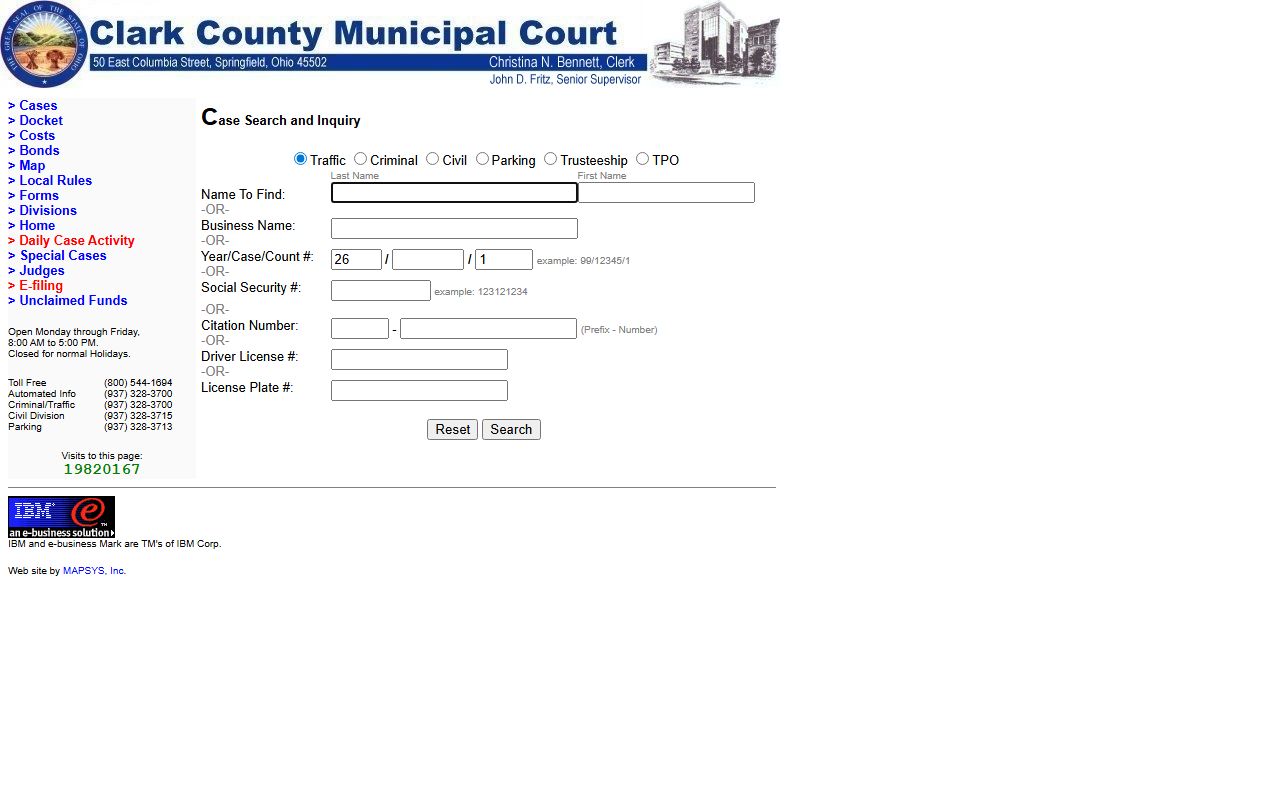
Its field layout is useful because it supports several routes when a defendant's exact case number is not known.
Clark County Case Search Fields
The Municipal Court search form exposes more search options than the jail roster. It has case-type tabs for Traffic, Criminal, Civil, Parking, Trusteeship, and TPO. For a court record after a jail arrest, the Criminal tab and name search are usually the most direct route, but citation and license fields can help when the arrest followed a traffic stop or citation-based case. Users should avoid entering sensitive identifiers unless the court form requires them for a specific official purpose.
| Field Label | Type | Required | Notes |
|---|---|---|---|
| Case type tabs | Tab control | Optional | Traffic, Criminal, Civil, Parking, Trusteeship, TPO. |
| Last Name / First Name | Text | Optional, useful | Primary route for defendant-name search. |
| Business Name | Text | Optional | Alternate party search. |
| Year / Case / Count # | Split text field | Optional | Example format shown as year, case, and count. |
| Citation Number | Text | Optional | Useful for traffic or citation-linked cases. |
| Driver License / Plate | Text | Optional | Traffic and parking search routes. |
Charges Filed After Clark County Arrest
Formal charges are built through charging documents. A complaint may start a case soon after arrest. An information is a prosecutor-filed formal charge used when allowed and often tied to waiver of indictment. An indictment is returned by a grand jury, which the Clark County Prosecuting Attorney's Office convenes and conducts for felony prosecutions. The prosecutor page names Daniel P. Driscoll as Clark County Prosecutor and explains that the office represents the State of Ohio in felony prosecutions arising from crimes committed in Clark County.
| Document | Who Uses It | What It Does |
|---|---|---|
| Complaint | Officer or prosecutor | Starts or supports an initial criminal charge, often early in the case. |
| Information | Prosecutor | Files a formal charge when procedure allows without a grand-jury indictment. |
| Indictment | Grand jury | Formally charges a felony after grand-jury review. |
The Clark County Prosecuting Attorney page documents the office's felony and grand-jury role.
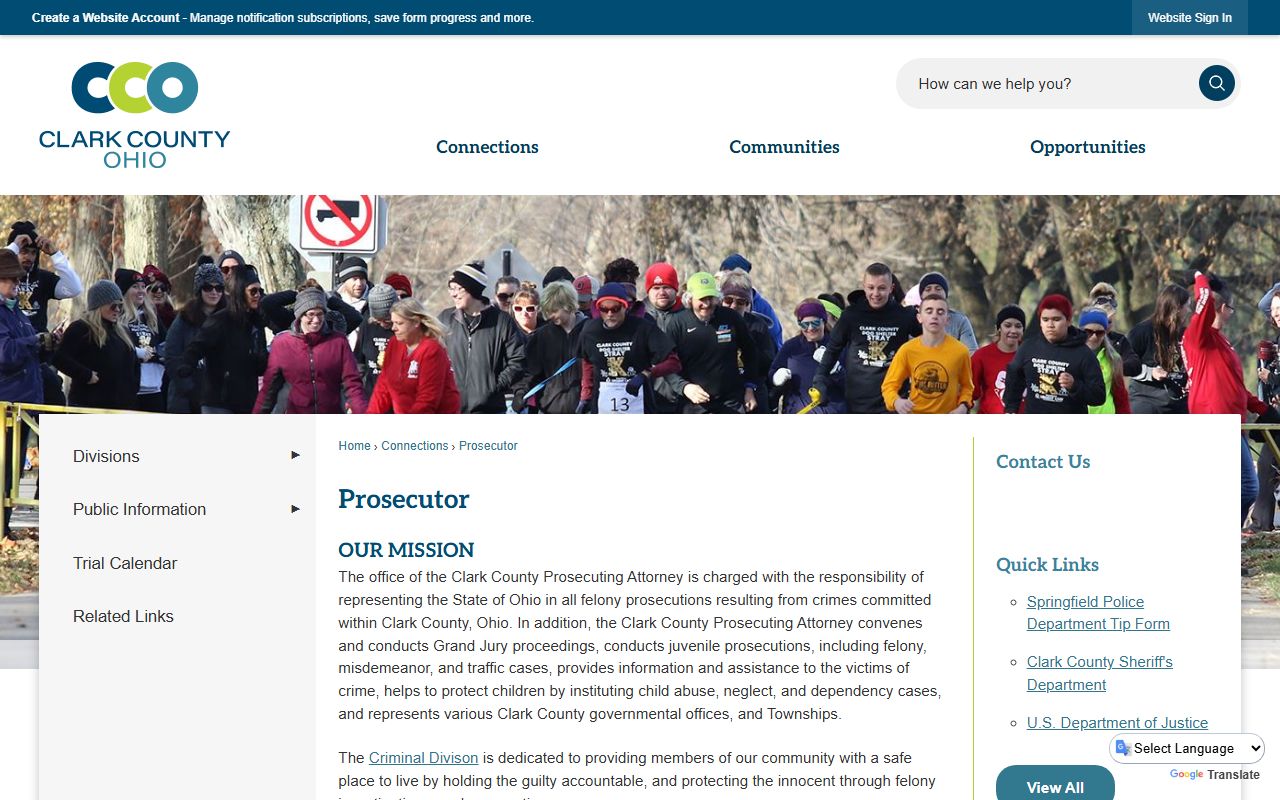
That prosecutor role is the link between a jail arrest and the court records that track the filed charge.
Clark County Charge Status Records
A charge can change after the arrest. Prosecutors may amend a count, reduce it in plea negotiations, dismiss it, or ask a grand jury to indict a different charge. A court record can also show that a municipal felony matter was bound over to Common Pleas, that a capias was issued after a missed appearance, or that a disposition ended the case. The safest reading is to treat the roster charge as an early custody clue and the court docket as the place to track filed charge status.
| Status | What It Means |
|---|---|
| Pending | The charge has been filed and has not been resolved. |
| Amended | The original charge or count was changed by later filing or court action. |
| Reduced | The charge was lowered to a lesser offense, often through plea or prosecutorial action. |
| Dismissed | The count was removed by the court or prosecutor. |
| Nolle prosequi | The prosecutor declined to proceed on the charge. |
| Bound over | A felony matter moved from municipal-level handling to Common Pleas. |
Clark County Arraignment Records
The Municipal Court daily schedule search is useful for court records after an arrest because it includes schedule, docket results, and criminal arraignment query options. The captured form has filters for case type, date, beginning time, end time, and judge. A newly arrested person may appear on a daily arraignment list before the broader case history is easy to read from the docket. The court's daily schedule should still be checked against the case-search page and the clerk's office when timing is critical.
| Daily Schedule Field | Type | Notes |
|---|---|---|
| Query | Control | Schedule, docket results, and criminal arraignments. |
| Cases | Checkbox or filter | Traffic, criminal, civil, and parking filters. |
| Date and time | Date and time fields | Used to narrow upcoming or same-day hearings. |
| Judge | Selection filter | Captured names include Stephen A. Schumaker, Valerie J. Wilt, Ann M. Ringler, James N. Griffin, and Daniel D. Carey. |
Bond Records After Arrest
Clark County's captured official pages did not publish a jail-specific bond payment page or local bail schedule. Bond information therefore has to be confirmed through the jail, Municipal Court, Common Pleas, or the case docket. The Municipal Court operates criminal and traffic matters from the courthouse and lists criminal and traffic phone access through 937-328-3700. The Common Pleas Clerk legal division lists 937-521-1680 for docket errors or omissions. A hold, detainer, warrant, probation matter, state hold, federal matter, or immigration hold can keep a person in custody even if one bond is paid.
| Bond Type | How It Works |
|---|---|
| Cash bond | Money is paid directly to secure release while the case is pending. |
| Surety bond | A licensed bail bond agent guarantees appearance for a fee. |
| Personal recognizance | The person is released on a written promise to appear, often with conditions. |
| No-bond hold | Release is blocked until a court changes the hold or another agency clears it. |
Clark County Warrants and Arrest
No public Clark County Sheriff warrant-search portal was located in the official research. The county-specific fallback is the Sheriff's Records Requests and Warrants contact, Nikki Callahan, at 937-521-2073. Municipal Court and Common Pleas docket entries can also show bench warrants, capias entries, failure-to-appear events, bond revocations, and recall or quash dates. Ohio eWarrants exists as a statewide system for criminal justice agencies, but the captured state page does not present it as a public name-search portal.
- Bench warrant
- A judge-issued warrant, often after failure to appear or violation of a court order.
- Capias
- A court order directing arrest, commonly seen in criminal case dockets.
- Detainer
- A hold or request from another agency or jurisdiction.
Charges vs Convictions
A court record after a jail arrest may show charges long before a case ends. A charge is an accusation or filed count. A conviction is a finding of guilt by plea, verdict, or other final adjudication. Public users should not treat an arrest, booking record, warrant, or pending charge as a conviction. The court docket should be read through the latest disposition and any later sealing or expungement order.
| Point of Comparison | Charge | Conviction |
|---|---|---|
| Case stage | Filed accusation | Final guilt finding or plea outcome |
| Can it change? | Yes, it can be amended, reduced, or dismissed | May be appealed, sealed, expunged, or later affected by court order |
| Where to verify | Court docket and charging document | Final judgment or disposition entry |
Sealed and Expunged Records
ORC 2953.32 governs sealing or expungement of eligible Ohio criminal conviction and bail-forfeiture records. The terms are related but not identical. Sealing limits public access to a record. Expungement can mean destruction or treatment as though the record no longer exists, depending on the statute and order. Eligibility depends on the case type, disposition, timing, prior record, and court order. Juvenile records, victim information, active investigations, and sensitive records may also have separate access limits.
| Question | Sealed | Expunged |
|---|---|---|
| Public visibility | Hidden from routine public access | Removed or treated under the expungement order |
| How it happens | Court order under Ohio law | Court order under Ohio law |
| What to check | Disposition, eligibility, and the sealing entry | Disposition, eligibility, and the expungement entry |
Restricted Clark County Court Records
Some records tied to a jail arrest may be limited even when the case is real. The sheriff's request form lists denial reasons such as open case or under investigation, juvenile matter, sensitive matter for safety or victim privacy, discovery required through the court system, and other reasons. The Common Pleas Legal Division also warns that online records are current as of the prior business day, updated nightly, and may lag filings or judicial action. Records before 1990 are not available online through that Common Pleas source.
Important: Use the originating court or sheriff's records unit to verify any court record after an arrest before relying on it.